

What Does MOQ Mean? A Factory-Side Guide for Founders
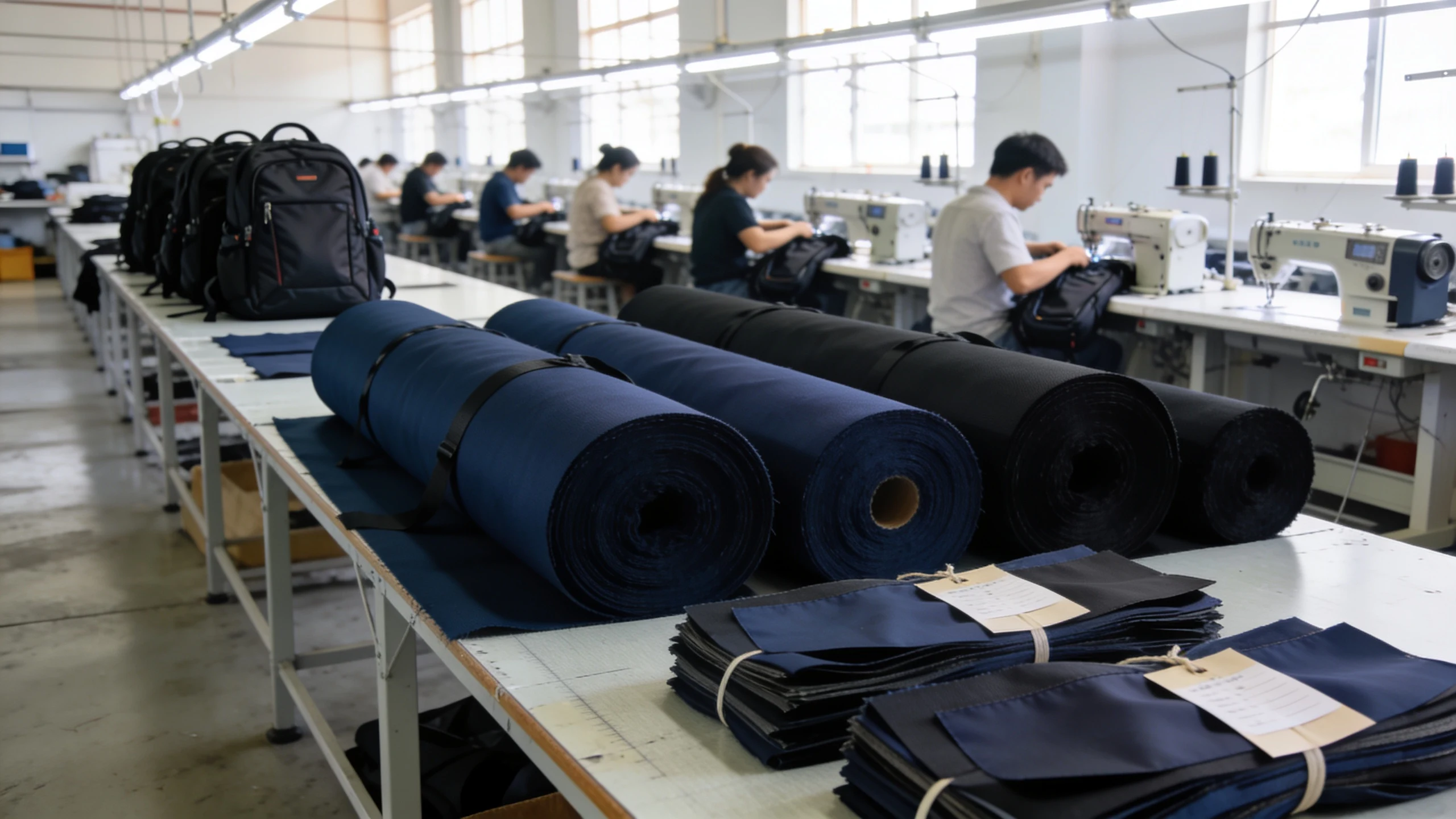
MOQ stands for minimum order quantity: the smallest production run a factory will accept for your product. It is the first number that shocks new founders, and the most misunderstood one in manufacturing. This is what MOQ actually covers, why factories hold the line on it, and the real ranges I see for bags, vests, and technical soft goods.
What MOQ actually means
When a factory quotes you an MOQ of 500 units, they are not guessing at a number that sounds impressive. They are telling you the smallest run where your order stops losing them money.
A production run has fixed costs that exist whether you make 50 units or 5,000. The line has to be set up for your product. Patterns and markers have to be prepared. Operators have to learn your construction, and the first units off a line are always the slowest and the most error-prone. Those costs get spread across every unit in the run. Below a certain quantity, the math simply stops working.
MOQ usually applies per style, and sometimes per colorway. Two hundred units split across four colors is not one order of 200. It is four orders of 50, and the factory prices it that way.
Why factories set MOQs (it is not greed)
Material minimums come first
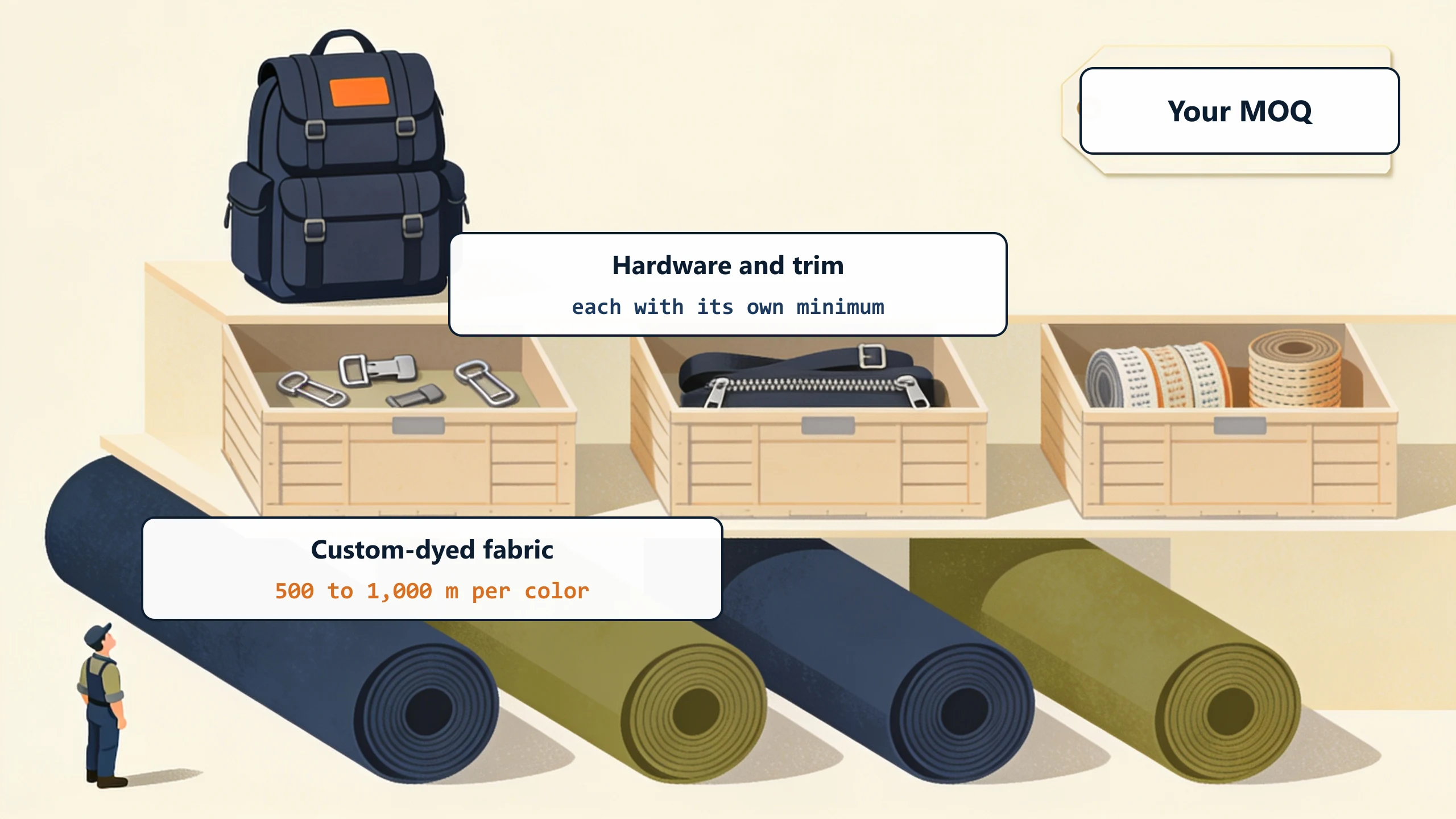
Your factory buys fabric from a mill, and the mill has minimums of its own. Custom-dyed fabric commonly starts at 500 to 1,000 meters per color. A single technical backpack might use a meter and a half of the main body fabric. If your run only needs 300 meters, someone has to eat the difference or you have to switch to a stock color the mill already runs.
Hardware works the same way. Custom buckles, custom zipper pulls, and woven labels all carry their own minimums from their own suppliers. Your MOQ is really the top of a pyramid of everyone else’s MOQs.
Line changeover is expensive
A sewing line is a crew of people arranged in a sequence, each doing one part of the construction. Changing what the line builds means rebalancing that sequence, moving machines, and retraining hands. That can take a day or more of reduced output. Factories protect themselves from orders too small to justify the disruption.
Small orders carry the same overhead as big ones
Quoting, sampling review, production planning, inline quality checks, final inspection, export paperwork. All of it happens for a 200-unit order and a 20,000-unit order alike. The smaller the run, the larger that overhead looms in the unit price.
Real MOQ ranges for soft goods
Every factory is different, but after years on factory floors here are the honest ranges I see for sewn goods:
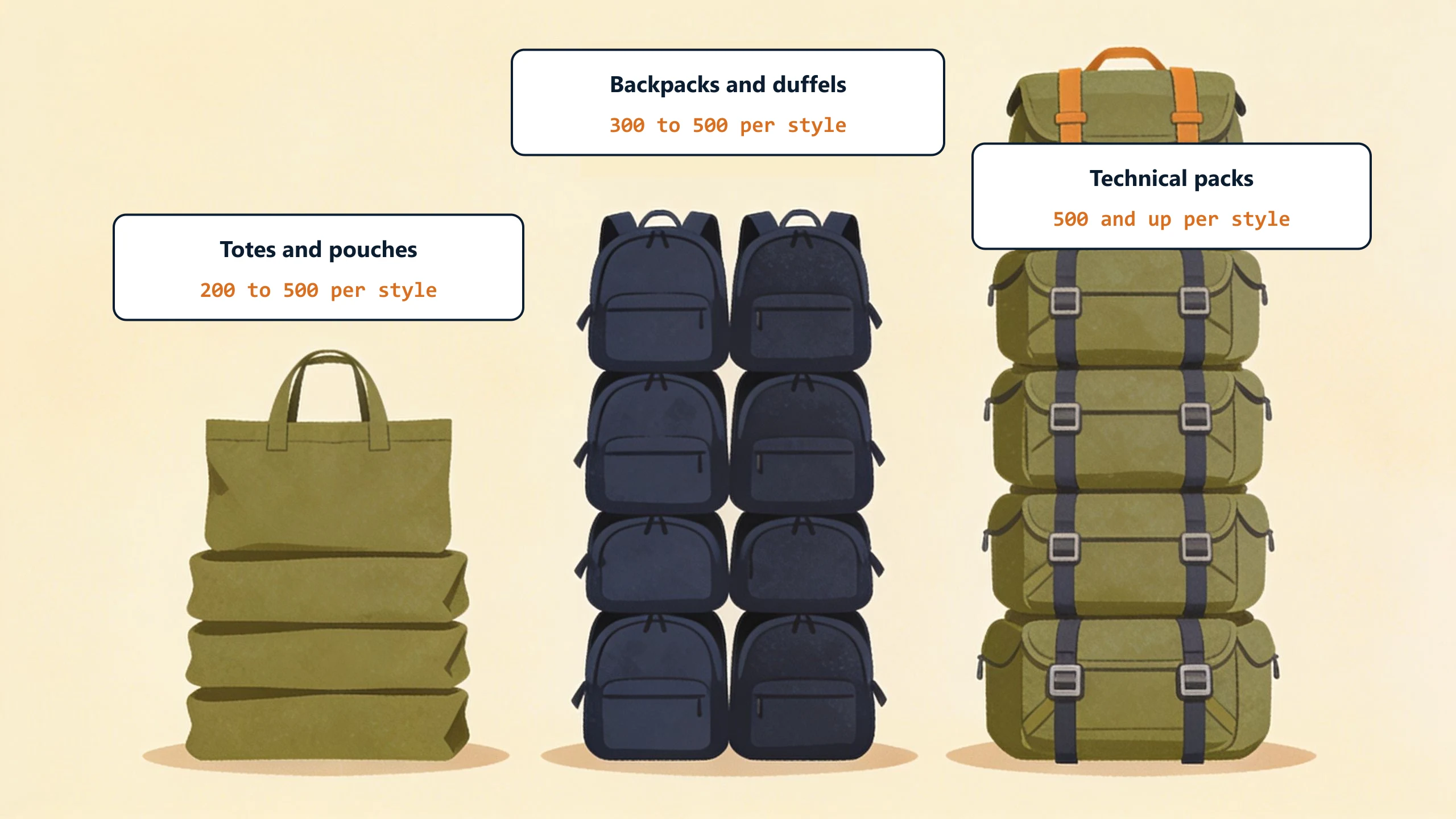
- Simple totes and pouches: 200 to 500 units per style.
- Standard backpacks and duffels: 300 to 500 units per style.
- Technical packs, tactical gear, load-bearing vests: 500 units and up. More construction steps, more specialized materials, more operator training.
- Anything with custom-dyed fabric or custom hardware: expect the material minimums, not the sewing, to set your floor.
If a factory advertises “no minimum” for custom technical products, be careful. Either the price per unit will be extreme, the product is coming off a shelf with your logo added, or the quality control is nobody’s job.
How to negotiate MOQ down without burning the relationship
You have more room than you think, but the room comes from removing the factory’s real costs, not from asking nicely.
- Use stock materials. Choosing fabrics and hardware the factory already buys removes the mill minimum problem entirely. This is the single biggest lever.
- Consolidate colorways. One color at 400 units beats four colors at 100 each. Launch in one color, add colorways when you reorder.
- Accept a small-run surcharge. Many factories will run below MOQ for a higher unit price. If the math works for your margins, it is a legitimate way to test a market.
- Phase your order. Committing to a second run on a schedule gives the factory confidence to flex on the first one.
What to do this week
Price your product at three quantities: the factory’s stated MOQ, half of it with a surcharge, and double it. The spread between those unit costs tells you exactly what the MOQ is protecting. If you want a real quote instead of a spreadsheet estimate, tell me what you’re trying to make and I’ll come back with line items.